

Room 14 · Made-to-order solid wood furniture · Concept
Lemnor
Solid wood, made to order.
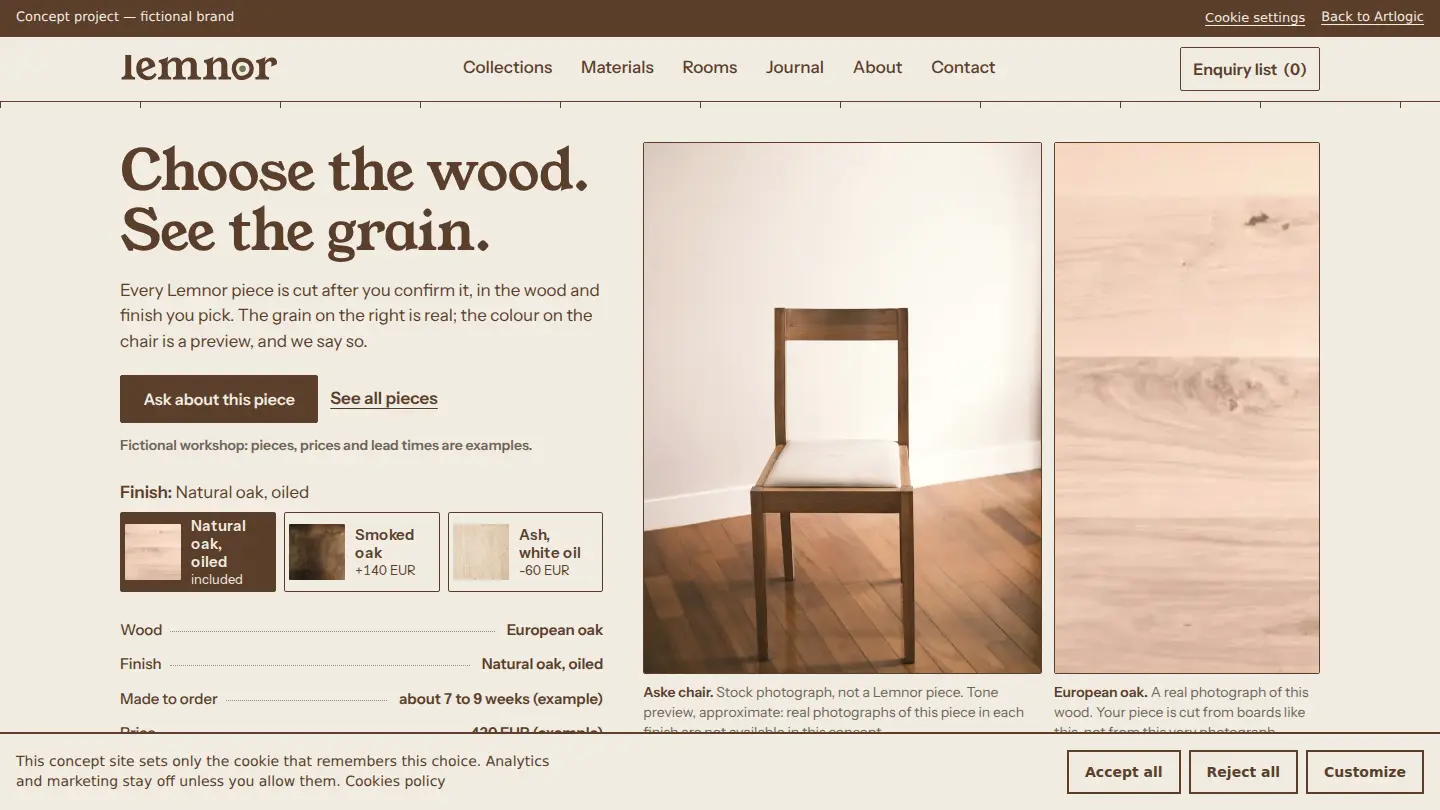
Lemnor, a fictional maker of solid-wood furniture. Choosing a finish changes the piece photo and shows the real grain of that wood beside it.
Concept project — fictional brand. This project was created by ARTLOGIC to demonstrate a possible brand and digital experience. The organization, name, people, prices, and data shown are fictional. This is not client work and does not represent measured business results.
01 The brief
- The brand
- Lemnor is a fictional workshop making solid-wood furniture to order. Its line is "Solid wood, made to order."
- The problem
- Buying furniture made to order means choosing a finish without seeing it. The site presents collections, materials and a journal, and lets a visitor pick a piece and finish before sending an enquiry.
02 The idea
Choose the finish, see the wood
- What you see
- On a piece page, three finish chips sit beside the photograph. Selecting one crossfades a close-up of that wood grain, shifts the tone of the piece photo and updates the cutting list. A caption says the tone is an approximate preview.
- How it works
- Each finish stores a real wood photograph and a set of CSS filter values for the preview. The chosen finish is kept in the address so the view can be shared.
03 Design system
- Birch Ground#F2ECE2 groundPage, header and chips at rest.
- Walnut Ink#5A3E2B inkAll text, borders and the primary button.
- Moss Marker#6F7A4F accentUsed only to mean "made to order".
- Muted Walnut#6E6458 mutedSecondary text and hints.
- Type
- Young Serif
Page and section headings, piece names. - Instrument Sans
Body text, labels and forms, with tabular figures.
- Young Serif
- Edges
- Flat, with 1.5px ink borders and 2px corners. The only soft shadow is the contact line under the piece in the sample stage.
- Motion
- The grain crossfades in a fraction of a second. Transitions are switched off under reduced motion.
04 Process
Pre-production
Pre-production set the thesis, the sample-board direction, the routes and the data for pieces and finishes. It also logged the open gaps, such as pieces without photos.
Build
The build followed a written plan with the finish chooser as the signature, plus collections, materials, rooms, journal and enquiry pages.
Finish review
Impeccable finish-review rounds compared the built pages with the direction contract and returned an ordered list of fixes.
Fixes
The fixes were applied and checked again, and the design system was documented from the finished build.
05 Technology and accessibility
- Stack
- Next.js 16, Tailwind CSS 4 and TypeScript, inside the studio's single application.
- Particular to this site
- Finish selection with crossfading grain photographs
- CSS filter tone preview
- Room viewer with pressable hotspots
- Access
- Finishes form a radio group with arrow, Home and End keys
- Choosing a finish is announced in a polite live region
- Each finish shows a name and price change in text, not colour alone
- The grain panel has a text description
- Skip link and visible focus
- Prefers-reduced-motion switches off the crossfade
- Tests
- Covered by its own Playwright end-to-end spec and a unit test file for its logic.
06 Honest notes
Lemnor is a fictional brand and this site is a concept by Artlogic. Prices and lead times are examples.
The enquiry form is a demo. It stores nothing and says so on the page.
Photographs are free Unsplash stock standing in for the fictional pieces and rooms, and some look rendered. Stock cannot show one piece in three finishes, so the tone shift is a labelled preview. Generated images are planned to replace them.
07 See it
Fictional prototype. A concept by ARTLOGIC for a fictional brand. English only.